Short answer
The strongest crypto and Web3 businesses to start in 2026 are regulated ones: stablecoin payments, tokenization of real-world assets, licensed exchanges and brokerages, wallet and custody infrastructure, payment rails for AI agents, and security tooling. Hong Kong, Singapore, the EU, the US and the UAE now all have clear rules, and they reward teams that build compliance in from day one.


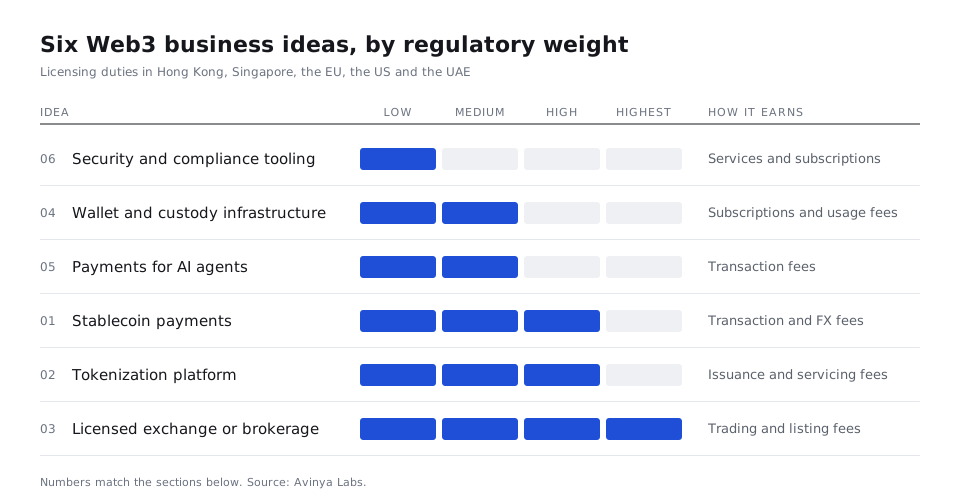
| Business idea | What you build | How it earns | Regulatory weight |
|---|---|---|---|
| Stablecoin payments | Checkout, payouts or cross-border settlement in stablecoins | Transaction and FX fees | High |
| Tokenization platform | Issuance and servicing of tokenized funds, credit or property | Issuance and servicing fees | High |
| Licensed exchange or brokerage | Trading with custody, KYC and market surveillance | Trading and listing fees | Highest |
| Wallet and custody infrastructure | Embedded wallets and key management for other apps | Subscriptions and usage fees | Medium |
| Payments for AI agents | Rails that let software agents pay within set limits | Transaction fees | Medium |
| Security and compliance tooling | Audits, on-chain monitoring and reporting | Services and subscriptions | Low |
In 2025 the question was which Web3 business had the most hype. In 2026 it is which one can get licensed. Stablecoin laws are now in force or being finalised in every major market, and the searches have moved with them: people are looking up tokenization and stablecoins far more than “Web3 business”. Here are six crypto and Web3 business ideas that make sense this year, what each takes to build, and the rules to plan for in Hong Kong, Singapore, the EU, the US and the UAE.
1. Stablecoin payments
Stablecoins have become the most practical part of crypto: dollars and other currencies that move on a blockchain in seconds. The business opportunity is in the layer around them. That means merchant checkout, supplier payouts, payroll for remote teams, and cross-border settlement between businesses that are tired of slow and costly correspondent banking.
You do not need to issue a stablecoin to build here. Most companies integrate licensed stablecoins and focus on the customer experience, compliance and reconciliation. We built multi-currency stablecoin payment rails in five weeks, with settlement in under a second.
2. Tokenization of real-world assets
Tokenization turns ownership of an asset, such as a fund, a loan or a property, into a digital token that can be issued, transferred and settled on a blockchain. It has moved from pilots to real volume: tokenized real-world assets reached about $31.4 billion on-chain by mid-May 2026, up from around $6 billion in early 2025, according to RWA.xyz data reported by Yellow. Tokenized treasuries and private credit lead, because institutions understand them.
The opportunity for a new business is usually not the asset itself but the platform: issuance, investor onboarding, transfer restrictions, distributions and reporting. Token design matters as much as the code; our guide to tokenomics covers how to get it right.
3. A licensed exchange or brokerage
Exchanges remain the largest revenue pool in crypto, but the barrier is now the licence rather than the technology. In the EU, the MiCA transitional period ended on 1 July 2026, so serving EU clients requires full authorisation (ESMA's statement). Hong Kong licenses trading platforms through the SFC, and Singapore through MAS.
That makes a regional or niche exchange, or a brokerage that routes to licensed venues, more realistic than another global exchange. Our guide to launching a centralized exchange covers the architecture and licensing; we delivered a compliant exchange in 20 weeks, with 99.9% uptime since launch.
4. Wallet and custody infrastructure
Every fintech, marketplace and game that adds stablecoins or tokens needs wallets its users can actually operate. Embedded wallets, key management and recovery, multi-chain support and simple interfaces are a business in their own right, sold to other companies rather than to consumers. Custody for other people’s assets is regulated; non-custodial wallet software usually carries a lighter load, but it still needs serious security work. See our wallet development work.
5. Payment rails for AI agents
This is the newest idea on the list. AI agents are starting to buy things on people’s behalf, and they need a way to pay within limits a person has set. Card networks and AI companies have launched protocols for this, and stablecoins fit naturally because they settle instantly and can be programmed. Businesses here build spending controls, approval flows and audit trails for agent payments. We cover the protocols in agentic commerce: how AI agents shop.
6. Security and compliance tooling
Every business above needs audited smart contracts, transaction monitoring and regulatory reporting. That makes security and compliance tooling a steady business with lower regulatory weight of its own. Smart contract audits, on-chain analytics and reporting for licensed firms all fall here. Our smart contract audits page explains what a full audit covers.
What changed from 2025
Two ideas that topped most 2025 lists have dropped off this one. Play-to-earn gaming struggled to keep players once token rewards fell, and generic DeFi protocols face crowded markets and heavy security risk. Both can still work, but they are no longer the easiest places to start. Tokenization and stablecoin payments took their place because regulation now gives institutions the confidence to use them.
The rules by market
| Market | Stablecoins | Exchanges and service providers |
|---|---|---|
| Hong Kong | The Stablecoins Ordinance requires a licence to issue fiat-referenced stablecoins. The HKMA granted the first two licences on 10 April 2026 (HKMA). | Trading platforms are licensed by the SFC. |
| Singapore | MAS is consulting, until 16 October 2026, on the law for its single-currency stablecoin framework, including recognition of foreign issuers (MAS). | Digital payment token services are licensed by MAS. |
| European Union | MiCA covers stablecoin issuers (e-money and asset-referenced tokens). | The MiCA transitional period ended on 1 July 2026; firms need full authorisation. |
| United States | The GENIUS Act, signed on 18 July 2025, sets the federal framework for payment stablecoins (Congress.gov). | Registration and licensing depend on the activity, at federal and state level. |
| United Arab Emirates | The Central Bank's Payment Token Services Regulation (in force since 2024) requires a licence to issue dirham payment tokens and bans algorithmic stablecoins and privacy tokens (CBUAE rulebook). | It depends on where you operate. VARA licenses virtual asset activity in Dubai outside the DIFC (VARA), ADGM and the DIFC have their own regulators, and federal rules cover the rest. The Capital Market Authority replaced the SCA on 1 January 2026 (CMS). |
This is a starting point, not legal advice. Take advice in each market before you build, because the licence you need shapes the architecture.
How to choose between these Web3 business ideas
Start with a customer you can reach and a problem they already pay to solve, then choose the lightest regulatory path that serves them. A payments business for exporters in Hong Kong looks very different from a tokenized credit platform for European investors. Keep the first version narrow: one market, one asset or currency, one core flow done well. That is the same principle we apply to every product, described in our post on building a minimum lovable product.
From our work
Related: Web3 development
Frequently asked questions
What is the best crypto business to start in 2026?
Stablecoin payments and tokenization platforms have the strongest demand, because regulation in Hong Kong, Singapore, the EU, the US and the UAE now gives businesses and institutions the confidence to use them. The best choice depends on the customers you can reach and the licence you can realistically obtain.
What is tokenization?
Tokenization records ownership of an asset, such as a fund, a loan or a property, as a digital token on a blockchain, so it can be issued, transferred and settled faster and in smaller units.
Do I need a licence to start a crypto business?
Often, yes. Issuing stablecoins, running an exchange and holding customer assets are licensed activities in all five markets covered here. Software and tooling businesses usually carry a lighter load. Take legal advice in each market before you build.
Do I need to issue my own stablecoin to build a stablecoin business?
No. Most stablecoin businesses integrate existing licensed stablecoins and focus on payments, compliance and the customer experience. Issuing your own brings the heaviest regulatory requirements.
How long does it take to build a first version?
It depends on scope and licensing. For reference, we built stablecoin payment rails in five weeks and a compliant centralized exchange in 20 weeks.