

Introduction
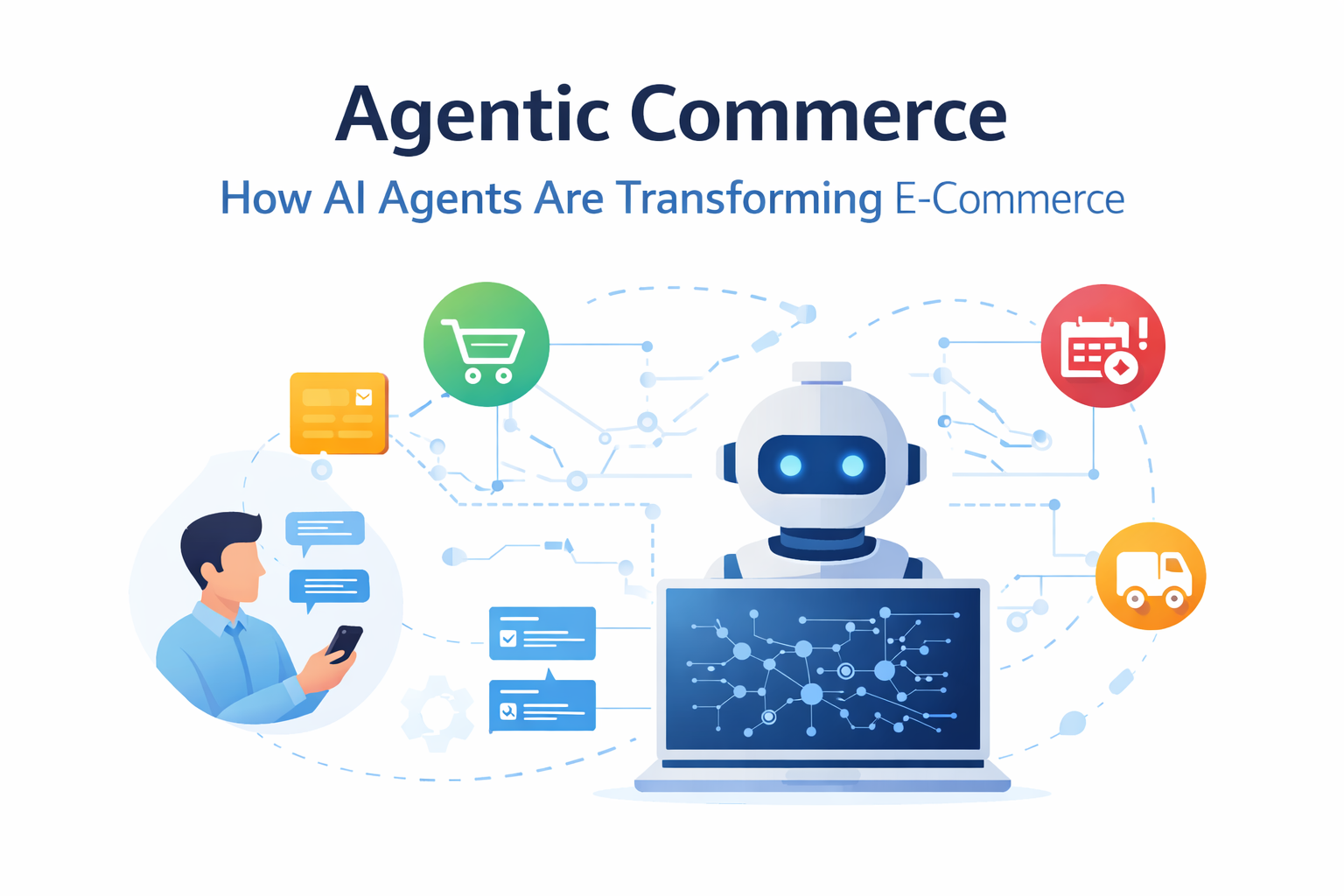
Agentic commerce is emerging as the next major shift in artificial intelligence and digital product development. After the rise of generative AI, the industry is now moving toward agentic AI systems that can reason, plan, and act autonomously.
At Avinya Labs, we see agentic commerce as the evolution of e-commerce from static websites to intelligent systems that can complete tasks on behalf of the user. Instead of searching, clicking, and filling forms, users interact with an AI agent that understands intent and executes actions automatically.
This guide explains what agentic commerce is, how it works, and how AI agents are changing the way modern digital products are built.
What is Agentic Commerce
Agentic commerce is a form of e-commerce where an AI agent can complete the entire transaction loop. The traditional flow runs user to search to filter to compare to checkout. The agentic flow instead runs user to AI agent to plan to execute to purchase to confirm, the user gives an instruction, and the system performs the steps automatically.
Take a request like “book me a nonstop flight to London under $600 next week with no red-eye.” An agentic system can search flights, check preferences, verify loyalty accounts, select the best option, and complete the purchase, all without further input. That’s the difference between generative AI and agentic AI.
Why Agentic Commerce Matters
Modern e-commerce has real friction: too many options, manual comparisons, repetitive forms, slow checkout, and little genuine personalization. Agentic commerce removes that friction by letting AI agents act on behalf of the user, delivering faster decisions, better personalization, fewer clicks, automation of routine purchases, and context-aware recommendations. Agentic systems turn websites into services.
From Generative AI to Agentic AI
Generative AI can write text, create images, and answer questions. Agentic AI goes further: it can plan actions, use tools, call APIs, make decisions, and complete tasks. This shift matters across e-commerce, fintech, travel, and SaaS.
The underlying pattern is straightforward: user to AI to reasoning to tools to API to action to result. Agentic commerce is built on this architecture.
Core Components of Agentic Commerce
Agentic systems rely on three main pillars.
Memory
Agents store context about the user, such as preferences, past purchases, size, budget, and habits, which is what allows real personalization. This can take the form of short-term memory, long-term memory, vector memory, or database memory, and some form of memory is required for agentic commerce to work at all.
Tools and API Integration
Agents must access external systems, including payment gateways, inventory APIs, booking APIs, shipping APIs, and CRM systems, since without tools an agent cannot actually act. A typical flow runs agent to API to payment to order to confirmation. Modern agentic systems rely heavily on this kind of API orchestration, built on platforms like OpenAI, Stripe, and AWS.
Reasoning
Reasoning allows agents to break tasks into steps. Planning a dinner party, for instance, breaks down into finding recipes, checking allergies, ordering groceries, and scheduling delivery. Reasoning models rely on LLM planning, tool calling, chain of thought, and multi-step execution, and this is the core of what makes agentic AI different from a simple chatbot.
Architecture of Agentic Commerce Systems
A typical architecture runs from the user through the UI to an agent, which draws on memory, tools, and APIs, and calls an LLM to reach a decision that becomes an action and, finally, a result. More simply: user to agent to planner to tool to API to database to response. Agentic commerce requires real orchestration, not just chat.
Hyper-Personalization in Agentic Commerce
Traditional e-commerce relies on broad segmentation. Agentic commerce works from individual context instead, remembering favorite brands, knowing budget, predicting needs, and auto-reordering items. That shift produces faster checkout, higher conversion, a better user experience, and less friction overall. Agents turn e-commerce into conversation.
Autonomous Purchasing
One of the biggest changes in agentic commerce is autonomous action: reordering groceries, renewing subscriptions, booking travel, and scheduling services without a person clicking through each step. Users set the permissions, and agents execute within them, which is why strong permission systems are essential.
Engineering Challenges in AI-driven Commerce
Agentic systems introduce new risks that developers have to solve for directly: security, permissions, liability, explainability, and governance. That’s what makes agentic commerce meaningfully more complex to build than a normal e-commerce storefront.
The Liability Problem
If an agent makes a mistake, who is responsible: the user, the developer, the retailer, or the payment provider? There’s no single universal answer yet, which is exactly why systems need to log every decision. Audit logs aren’t optional here.
Guardrails and Permissions
Agents need explicit limits. A system might allow an agent to buy groceries or renew a subscription on its own, while requiring approval for large payments or purchases from unknown vendors. Permission systems need to be granular, and the user needs to retain real control over the agent, not just a theoretical override.
Transparency and Explainability
Users need to understand why an agent acted the way it did. If a flight was selected, the agent should be able to show it chose that option because it was cheaper, matched a preferred airline, avoided a red-eye, and used available loyalty points. Explainability is what builds trust, and the UI needs to actually surface that reasoning, not just the result.
Security in Agentic Systems
Agentic commerce increases the attack surface: prompt injection, malicious APIs, fake data, and adversarial input all become live risks. The response is validation, sandboxing, permission checks, logging, and monitoring, all treated as required infrastructure, not optional hardening, for any production agent.
Multi-Agent Systems in Commerce
Future systems won’t rely on a single agent, they’ll coordinate multiple specialized agents: a travel agent, a calendar agent, a finance agent, a booking agent, working together and handing tasks between each other to reach a result. In practice: user to main agent to sub-agents to APIs to result. Multi-agent architecture improves accuracy and is widely considered the near-term future of agentic commerce.
Why Intelligent Commerce Will Grow Fast
Better LLMs, tool-calling support, mature API ecosystems, payment integrations, vector memory, and multi-agent frameworks are all converging at once. Agentic commerce is already showing up in travel, retail, fintech, SaaS, and marketplaces, a shift comparable to the earlier move from web to mobile.
Building Agentic Systems at Avinya Labs
At Avinya Labs, we build production-grade agentic systems including AI agents, workflow automation, API orchestration, multi-agent platforms, secure permission systems, and custom AI backends. We focus on real business systems, not demos, helping companies build the infrastructure agentic commerce actually runs on. We serve clients globally, including in Dubai, Singapore, and Hong Kong.
Frequently Asked Questions
What is agentic commerce?
Agentic commerce is AI agents autonomously performing commerce tasks, researching products, comparing options, and completing purchases, on a person’s or business’s behalf, rather than just answering questions about products.
How is agentic commerce different from a generative AI chatbot?
A generative AI chatbot answers questions and makes suggestions but stops short of taking action. An agentic commerce system has memory, tool access, and reasoning that let it complete multi-step tasks, including the purchase itself.
Can AI agents make purchases autonomously?
Technically yes, within permission boundaries the business defines, spending limits, approved vendors, and escalation rules that determine when a human has to confirm before the agent proceeds.
What are the main risks of agentic commerce for e-commerce brands?
The core risks are giving an agent too much autonomy without adequate guardrails (unauthorized purchases, brand-mismatched choices) and underinvesting in the validation layer that checks an agent’s decisions before and after it acts.
Do agentic commerce systems rely heavily on APIs?
Yes. An agent can only act on what it can reach through a tool or API, payment gateways, inventory systems, booking platforms, shipping providers, so API orchestration is effectively the backbone of any agentic commerce system.
Can small and mid-sized businesses build agentic commerce experiences?
Yes. SMBs can build agent-based commerce using existing LLM APIs, off-the-shelf payment and inventory integrations, and workflow automation tools, without needing to train custom models first.
Will agentic commerce become the default way people shop online?
Many in the industry expect it to, as better models, wider tool-calling support, and mature API ecosystems make agent-led shopping more reliable, though guardrails and trust-building will determine how fast adoption actually moves.
