

The Hidden Gap Between AI Pilots and Enterprise-Scale Reality
Enterprise AI deployment has become a strategic priority for organizations seeking productivity gains, operational efficiency, and competitive advantage. Yet despite significant investment, many AI projects never reach production or fail to deliver measurable business value. Most enterprises have already tested copilots, chatbots, predictive models, recommendation engines, or autonomous agents, and a large percentage of these initiatives never make it into production, or fail to create measurable business value after deployment.
The reality is simple: building a model is easy, but operating AI reliably inside a business is hard. Organizations often focus heavily on model selection while underestimating the complexity of production infrastructure, data pipelines, governance frameworks, security controls, monitoring systems, and organizational adoption. As a result, promising proofs of concept remain trapped in pilot environments.
At Avinya Labs, we’ve observed a recurring pattern across AI implementation projects: the challenge is rarely the model itself. The real complexity emerges when organizations attempt to integrate AI into existing workflows, governance requirements, compliance frameworks, and production infrastructure. The gap between a successful proof of concept and a production-ready AI system is where most initiatives struggle.
This article explores why AI projects fail to reach production in 2026 and provides a practical roadmap for deploying, scaling, monitoring, and integrating AI systems successfully.
Enterprise AI Deployment Challenges
Most AI initiatives follow a familiar pattern: an executive team approves an AI initiative, the data science team develops a prototype, early demonstrations generate excitement, the pilot succeeds in a controlled environment, and then production deployment stalls.
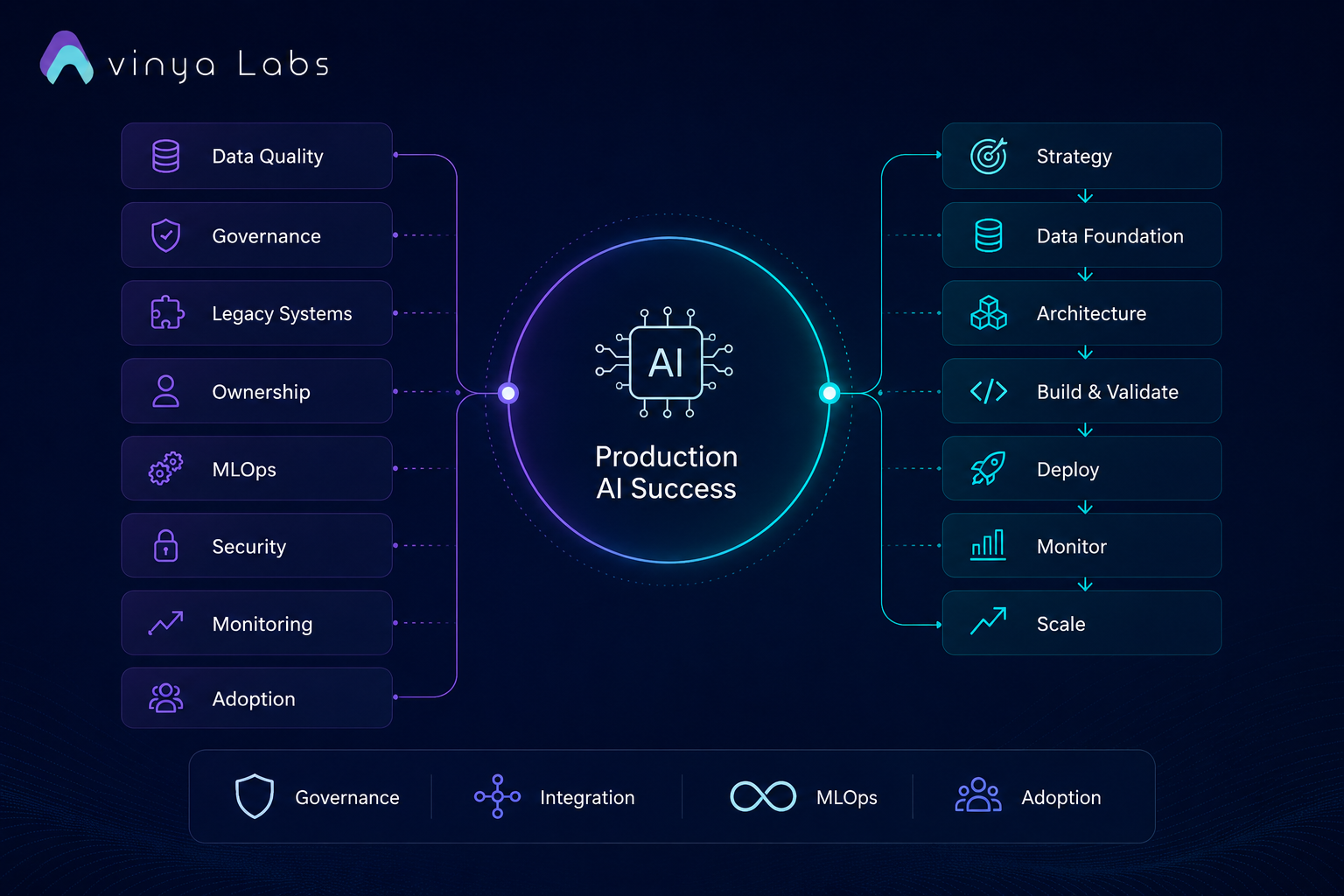
The failure rarely occurs because the model performs poorly. Instead, organizations discover challenges involving fragmented enterprise data, regulatory requirements, security concerns, legacy system integration, lack of governance, operational ownership confusion, employee adoption resistance, and cost management issues. By the time these issues emerge, momentum has often disappeared.
The 8 Most Common Reasons AI Projects Fail
1. Poor Data Quality and Data Readiness
Every AI system depends on data, and enterprise data is often inconsistent, incomplete, duplicated, siloed across departments, poorly labeled, or missing governance controls. Many organizations mistakenly assume modern foundation models can compensate for poor data quality. They cannot: AI amplifies underlying data problems at scale, producing incorrect customer recommendations, hallucinated responses, misleading business insights, and inaccurate forecasts. Without trusted data foundations, production deployment becomes impossible.
Solution
Establish centralized data governance, data quality monitoring, metadata management, data lineage tracking, and master data management. Treat data as infrastructure, not as a byproduct.
2. Lack of AI Governance
Many organizations deploy AI before defining rules for data access, model approvals, compliance reviews, risk assessments, auditability, and human oversight. This becomes especially dangerous when deploying generative AI, autonomous agents, customer-facing assistants, or financial decision systems. Governance cannot be added later; it must be embedded from the beginning.
Solution
Create an AI governance framework covering responsible AI policies, risk classification, human review checkpoints, model approval workflows, audit trails, and regulatory compliance.
3. Legacy System Integration Challenges
Most enterprise environments contain ERP platforms, CRM systems, databases, internal APIs, document repositories, and workflow engines, and AI systems must interact with all of them. A chatbot that cannot access business systems provides limited value, and an AI agent that cannot trigger workflows remains a demonstration. Integration, not intelligence, is often the real bottleneck.
This challenge is particularly common among enterprises adopting AI for sales operations, procurement, compliance, customer support, finance, and construction workflows. At Avinya Labs, many AI transformation engagements begin not with model development but with mapping existing systems, data flows, and operational processes to identify where AI can be embedded to create measurable business value.
Solution
Build an integration layer using APIs, event-driven architectures, workflow orchestration platforms, service mesh architectures, and secure connectors. AI should become part of existing workflows rather than existing as a separate technology layer.
4. No Clear Business Ownership
Many AI projects become trapped between departments: IT owns infrastructure, data teams own models, business units own outcomes, and security owns approvals. When nobody owns end-to-end success, deployment stalls. AI initiatives require a designated business owner accountable for adoption, ROI, operations, and governance. Without ownership, pilots rarely scale.
Solution
Assign a business sponsor, an AI product owner, and a technical lead. This leadership triad should drive deployment decisions and accountability.
5. Inadequate MLOps and LLMOps Infrastructure
Many organizations build models but lack systems to manage them. Common gaps include no deployment pipeline, no version control, no rollback mechanisms, no monitoring, no retraining process, and no evaluation framework. As models evolve, operational complexity increases rapidly.
Solution
Implement MLOps and LLMOps capabilities: CI/CD pipelines, model registries, feature stores, automated testing, canary deployments, continuous evaluation, and automated retraining workflows. AI should be treated like production software.
6. Security and Compliance Risks
Enterprise leaders increasingly ask where data is stored, whether prompts can leak confidential information, who can access models, how decisions are audited, and what happens during a model failure. These concerns often delay deployment, especially in banking, healthcare, government, insurance, and financial services. Security cannot be an afterthought.
Solution
Implement encryption, role-based access controls, prompt security controls, model access governance, data residency policies, audit logging, and threat monitoring.
7. Lack of Monitoring After Deployment
Traditional software behaves predictably; AI systems do not. Production risks include data drift, model drift, hallucinations, cost overruns, performance degradation, and prompt injection attacks. Without monitoring, failures remain invisible until customers complain.
Solution
Track metrics across four layers. Technical metrics cover latency, throughput, error rates, and uptime. Model metrics cover accuracy, precision, recall, and drift indicators. LLM metrics cover hallucination rates, response quality, grounding scores, and safety violations. Business metrics cover revenue impact, cost reduction, productivity gains, and customer satisfaction.
8. Organizational Resistance and Change Management Failure
The biggest obstacle is often not technical, it is human. Employees worry about job displacement, increased monitoring, loss of control, and workflow disruption. Without trust and involvement, adoption remains low.
Solution
Create AI champions programs, internal training initiatives, transparent communication, human-in-the-loop workflows, and feedback-driven implementation. AI adoption is a business transformation project, not merely a technology deployment.
Learn more about our AI Development Services
What Production-Ready AI Looks Like
A production-ready AI system is more than a model connected to a user interface. It is an operational layer embedded into business processes, capable of accessing enterprise knowledge, triggering workflows, maintaining audit trails, enforcing governance policies, and continuously improving through monitored feedback loops.
At Avinya Labs, we approach AI implementation as a systems engineering challenge rather than a model deployment exercise. This means designing the complete architecture, from data ingestion and retrieval pipelines to workflow automation, observability, governance, and user adoption, ensuring AI delivers measurable outcomes in real-world environments.
The organizations seeing the highest return on AI investment are not simply deploying models. They are building integrated AI systems that become part of how the business operates every day.
Enterprise AI Deployment Roadmap
Phase 1: Strategy and Opportunity Assessment
Define business objectives, ROI expectations, success metrics, risk profile, and stakeholder alignment. The key questions to answer: what problem are we solving, how will value be measured, and who owns outcomes? The output is a prioritized AI opportunity roadmap aligned with business goals.
Phase 2: Data Foundation
Build data pipelines, data governance, data quality controls, data cataloging, and access policies. The output is a trusted, AI-ready data layer.
Phase 3: Architecture Design
Design the AI application architecture, model strategy, vector databases, knowledge systems, security controls, and integration framework. For organizations beginning their AI journey, partnering with an experienced implementation team can significantly reduce deployment risk, since architecture decisions made at this stage often determine whether a project scales successfully or becomes another isolated pilot. The output is a production-ready technical blueprint.
Phase 4: Development and Validation
Build models, RAG pipelines, AI agents, business workflows, and evaluation frameworks, then validate accuracy, safety, security, and compliance. The output is an enterprise-approved AI solution ready for deployment.
Phase 5: Production Deployment
Deploy using Kubernetes, containerized workloads, API gateways, auto-scaling infrastructure, and CI/CD pipelines. The output is a stable production environment.
Phase 6: Monitoring and Observability
Implement real-time monitoring, drift detection, cost tracking, security alerts, and business KPI dashboards. The output is operational visibility and continuous improvement capabilities.
Phase 7: Scale and Optimization
Expand into additional use cases, departments, geographic regions, and agent capabilities, introducing multi-agent orchestration, workflow automation, and autonomous operations. The output is an enterprise-wide AI platform that continuously compounds value.
The Emerging Enterprise AI Stack for 2026
Leading organizations increasingly standardize around five layers. The application layer covers AI copilots, AI assistants, and autonomous agents. The intelligence layer covers foundation models, fine-tuned models, and Retrieval-Augmented Generation (RAG). The knowledge layer covers vector databases, enterprise knowledge graphs, and document intelligence systems. The operations layer covers MLOps, LLMOps, monitoring, and governance. The infrastructure layer covers cloud environments, hybrid cloud deployments, private AI infrastructure, and GPU compute clusters.
Organizations that treat AI as a complete operational stack, not a standalone model, are significantly more likely to achieve production success.
Enterprise AI Deployment Success Factors
At Avinya Labs, we’ve found that the organizations achieving the greatest return on AI investment are not necessarily those using the most advanced models. They are the ones that treat AI as a business capability, supported by strong data foundations, governance, operational processes, and clear ownership. Production success comes from building the ecosystem around the model, not simply deploying the model itself.
The primary reason AI projects fail in 2026 is not because the models are insufficient. The real challenge lies in transforming a promising prototype into a reliable business capability. Successful enterprises recognize that production AI requires five foundations: high-quality governed data, strong AI governance, deep integration with business workflows, continuous monitoring and operations, and organizational adoption and ownership.
The companies that master these foundations will move beyond isolated pilots and build AI systems that generate measurable business outcomes at scale. The future belongs not to organizations that experiment with AI, but to those that operationalize it. And operationalizing AI requires far more than a model, it requires strategy, systems, governance, and execution. That is where enterprise AI transformations are ultimately won or lost.
Frequently Asked Questions
Why do most enterprise AI pilots fail to reach production?
The model itself is rarely the problem. Most pilots stall on production infrastructure, data pipelines, governance frameworks, security controls, monitoring, and organizational adoption, the operational layer around the model, not the model.
What is AI governance and why does it matter for deployment?
AI governance is the set of policies, permission controls, and audit trails that determine what an AI system can do, who approves its actions, and how outcomes are tracked. Without it, enterprises can’t safely move an agent from a controlled pilot into live operations.
What is the difference between MLOps and LLMOps?
MLOps covers the infrastructure for training, deploying, and monitoring traditional machine learning models. LLMOps addresses the additional layer specific to large language models, prompt versioning, retrieval pipelines, token cost management, and continuous evaluation against drifting model behavior.
How long does enterprise AI deployment typically take?
Timelines vary by scope, but production-grade deployment (past the pilot stage) typically requires dedicated work on data readiness, governance, and integration, often several months beyond the initial proof of concept, not weeks.